Is Your Living Room Pushing People Apart? The Hidden Social Cost of Bad Furniture Placement
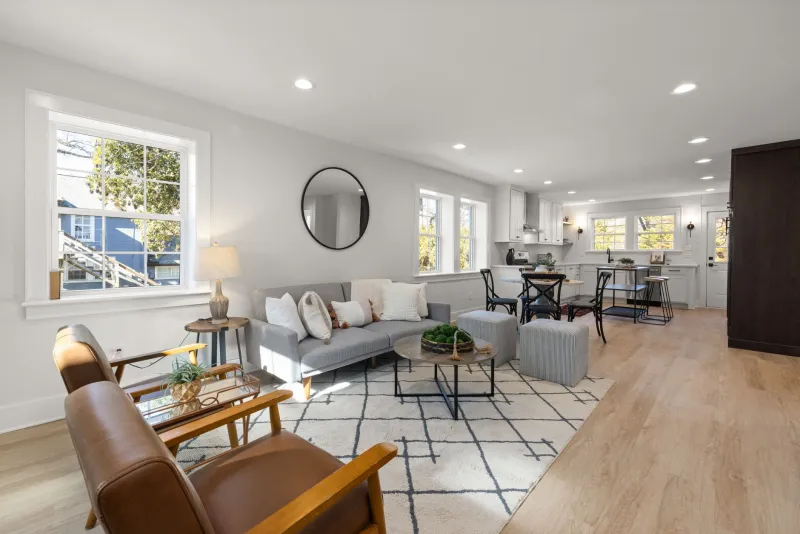
Picture a typical American living room. Sofa against the wall. TV mounted front and center. A couple of chairs angled toward the screen. Maybe a coffee table nobody really uses. Everyone sits down, faces forward, and... stares at the same rectangle of light.
It's comfortable. It's familiar. And according to researchers who study how physical space shapes human behavior, it might be quietly making you lonelier.
This isn't about aesthetics. It's about the way your furniture literally positions your body in relation to other people — and how that positioning either opens the door to real conversation or closes it without you ever noticing.
The Science of Sitting Together (Or Not)
Back in the 1950s, a Canadian psychiatrist named Humphry Osmond coined two terms that interior designers still reference today: sociofugal and sociopetal space. Sociofugal arrangements push people away from each other — think airport seating or waiting rooms where chairs are bolted in rows facing the same direction. Sociopetal arrangements pull people toward each other, encouraging eye contact, proximity, and genuine interaction.
Here's the uncomfortable truth: most American living rooms are accidentally sociofugal.
When furniture is arranged primarily around a television, the human body naturally orients toward the screen rather than toward other people in the room. Conversation becomes an interruption of the viewing experience rather than the point of gathering. You end up sitting near the people you love without actually being with them.
Environmental psychologists have found that face-to-face seating — even at slight angles — dramatically increases the likelihood of spontaneous conversation. The sweet spot, according to most research, is seating positioned between 90 and 120 degrees from each other. Close enough to feel connected. Open enough to feel comfortable.
Why This Matters More Right Now
The rise of remote work has fundamentally changed how Americans use their homes. For millions of households, the living room is no longer just a place to unwind in the evenings — it's also the place where someone is on a Zoom call at 2 p.m., where kids are doing homework, where the boundary between work and life has basically dissolved.
All of that togetherness-while-actually-being-separate creates what some therapists call parallel living — the experience of sharing a space with people you love without meaningfully engaging with them. You're in the same room. You're not really there.
The furniture layout didn't cause this, but it can absolutely make it worse. When your physical environment offers no natural invitation for connection — no seating arrangement that says sit here, face each other, talk — it's easy for parallel living to become the default mode, even when nobody wants it to be.
The Walls Are Not Your Friends
One of the most persistent myths in American home design is that pushing furniture against the walls makes a room feel bigger and more open. It doesn't. What it actually does is create a hollow, disconnected center and force everyone to sit as far apart as possible.
Floating your furniture — pulling it away from the walls and grouping it toward the center of the room — is one of the single most effective things you can do for both the look and the social function of a living space. It feels counterintuitive, but the room genuinely feels more inviting when seating is clustered together rather than pressed to the perimeter.
A good starting point: anchor your seating arrangement with a rug, and make sure every seat in the room is within comfortable conversation distance — roughly 8 to 10 feet from any other seat. Beyond that range, people have to raise their voices to talk, and raised voices feel like effort. Effort discourages conversation.
Rethinking the TV's Role
This is where things get a little controversial, but stay with us.
The television doesn't have to be the organizing principle of your living room. That's a design habit, not a design law.
In many European homes — and increasingly in American ones — the TV is treated as one element among several rather than the focal point everything else bows to. Seating is arranged for conversation first. The TV is positioned so it can be watched comfortably, but it doesn't dictate where every chair and sofa has to live.
If you have a large living room, consider creating two distinct zones: a conversational grouping with chairs and a sofa facing each other around a central coffee table, and a separate viewing area. The two don't have to fight each other. They just have to coexist with intention.
Small Changes, Real Shifts
You don't need to gut your entire living room to start feeling more connected in it. A few targeted adjustments can genuinely change how your household interacts.
Angle two chairs toward each other. Even a slight pivot away from the TV and toward another seat signals to your body — and your brain — that this is a place for conversation.
Add a second seating surface. A single sofa lined up against a wall gives everyone the same forward-facing orientation. Introduce an accent chair or a loveseat at an angle, and suddenly the room has geometry that invites people to look at each other.
Bring the coffee table closer. Most people position their coffee table too far from the sofa to actually use it comfortably. Pull it in. When people can reach their drinks without leaning forward awkwardly, they settle in. When they settle in, they stay longer. When they stay longer, they talk.
Reduce visual clutter. Rooms that feel chaotic and overwhelming tend to make people want to escape them rather than linger. A cleaner, more intentional layout — fewer pieces, better positioned — creates a sense of calm that actually makes people want to be in the space.
Designing for the Life You Want
Here's the thing about furniture: it's never just furniture. Every piece you choose, and every way you position it, is a quiet statement about how you expect your home to function and how you want to feel inside it.
A living room arranged for passive screen consumption will produce passive screen consumption. A living room arranged for conversation will produce conversation. It sounds almost too simple, but the research backs it up, and honestly, so does common sense.
If the past few years have left you craving more genuine connection at home — more of those easy, unhurried conversations that used to happen naturally — it's worth asking whether your furniture layout is helping or getting in the way.
The good news is that this is one of the most fixable problems in home design. You don't need a renovation. You need intention. Pull the sofa away from the wall. Angle a chair toward it. Create a space that says come sit, stay a while, let's actually talk.
Your furniture can do that. It just needs to be pointed in the right direction.